
The Call of the Loon
Updated: 2 days ago

"What as that?" my husband, Jay, asked one night as we were falling asleep in our tent in Mira River, Nova Scotia. The eerie call was one with which I had only recently become familiar. The cry of the Common Loon, previously only a descriptive line in books based in the Northwoods, was becoming a mysterious soundtrack of recent sightings on this trip. The first sightings were on Harvey Lake in Northwood, New Hampshire, and again on a small lake in Caratunk, New York. Actually, I had experienced Loons...experiences recorded from kayaks and hundreds of frames on my camera.

Side note: Photographing from a kayak is an experience in itself. "Setting out" involves pulling the kayak into the shallows; picking up Ella (our dog) and placing her in the boat; strapping my camera through the kayak's elastic cords on the back of the boat; putting the paddle and my water bottle into the boat; straddling the dog and the paddle and gingerly (clumsily?) sliding down into the seat; bending around to get my camera and slip the strap around my neck; picking up the paddle then using it to push myself off from shore (the kayak now likely sitting on the shoreline as the weight of me and the dog nestled it down).
And then setting out.
As each end of the paddle is pulled through the water, though, everything within me grows calm and quiet and connected to place. This place. This new place I get to explore from water level.
So here, on Harvey Lake, we set out -- Ella and I. Over those few evenings and mornings, I watched as a family of three Common Loons did their signature dives and pop- ups a distance away. I learned, by watching, how the several-months-old juvenile is learning to fish and feed on its own.

Yet, like many teenagers, the juvenile was still looking to her parents to bring her some food. In fact, sometimes she would taunt them until they fished for her.

That was interesting to watch. The parent would dive down, catch a small fish, then return to the young Loon. Both adult and juvenile would then dip their heads in the water and exchange the fish between their beaks. It was as if the adult were reminding the young one (for the thousandth time): "You have to put your head down into the water to catch fish with your long, sharp beak."
I don't know if that was their communication, but in human terms it is what I observed. Repeatedly. Life continuing on...
There was beauty in witnessing those moments: the calm, the real, the learning, the presence. That beauty took on a natural artistry in my next Loon sighting.
That next time was a few days later in Caratunk, Maine, in the heart of hidden rustic cabins and occasional "outdoor adventure" signposts. Lakes are abundant and forests are thick. It is sheer beauty.
I had the opportunity to borrow a kayak for 45 minutes from a local outfitter. That sparse hour on the small lake was one of the most connected occasions with Loons that I may ever experience.
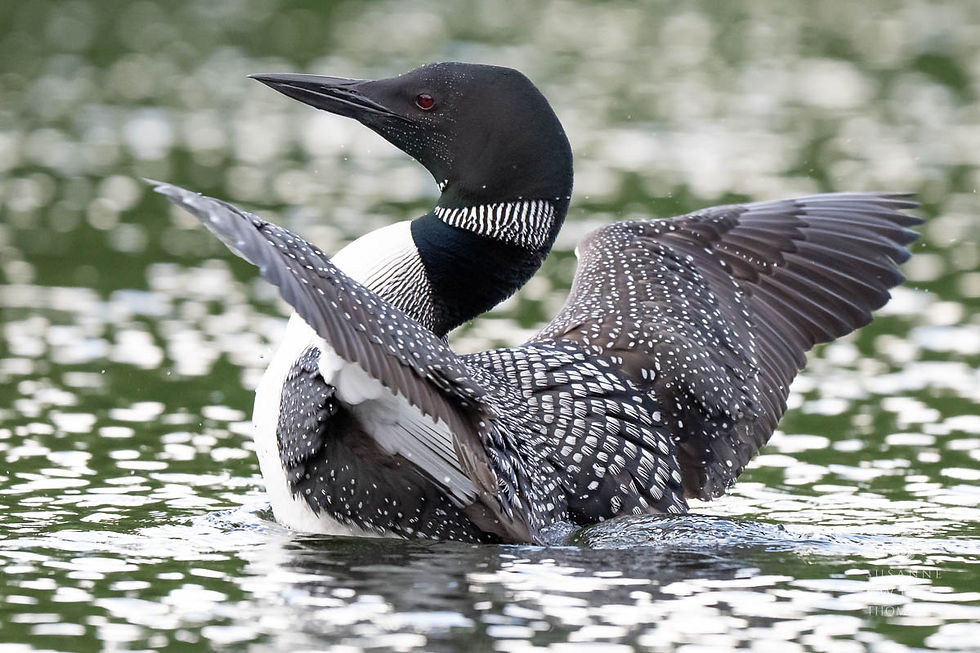
There were four of them -- two pairs of Common Loons. In between their now-familiar diving and gliding, though, they exhibited other mesmerizing movements. In several moments, there was a flurry of wings and water as one of the Loons lifted himself out of the lake, spreading and flapping his wings and displaying the oft-hidden bright white chest and underside feathers.

Droplets would fly, and just as quickly all would settle as the Loon returned to its floating, the black and white geometric design of the male now all that was obvious.

One of the things that I love about photography (contrary to popular opinion that you don't really observe because you click and move on), is that photography prompts me to slow down and observe. In fact, it has taught me. Many times -- in fact, most times -- with my camera, I'm not actually photographing but looking and observing, a habit and lifestyle learned through my lens. Too, there is the delight of seeing everything all over again as I edit on my screen. Between the intentionality of seeking and the long lens for capturing, I observe and internalize details that would otherwise never be evident to me. They filter into my being, filling me with wonder.
Such was the experience when, for the first time, I noticed how the deep black of the male Loon is sharply contrasted with the brilliant white "necklace" of the feathers near the base of their long neck.

Too, their seeming "flecks" of white patterns along their backs form intricate designs. There was the later fascination of learning that this stark contrast of black and white actually camouflages the male Loon, mimicking the interplay of light reflecting off of the water. I experienced that; again, a male lifted his body out of the lake and flapped his wings, the black and white and water and reflection creating modern art in the middle of a pine-bordered lake.
Then, all went quiet again. That same Loon settled back into the water, his stretching now at surface level. Quietly, slowly, he lifted one webbed foot and reached back with his beak, eventually lifting that foot to the back of his head.
In the minutes that followed, I witnessed how he would turn his head and gently lay it flat against his back.

Other times he would arch his neck, displaying so many beautiful patterns as they mirrored in the water...designs that flowed and morphed with each subtle movement.

I have gone on about the male Common Loon. Yet the female, too, was quietly swimming nearby, there in her own subtle beauty. But those words will need to wait for now.

In the quiet of that small lake, the water was the stage, the Loons were the dancers, and I was the mesmerized audience. You see, I not only view, edit, file and share these photos and words; the experience continues to penetrate deeply in my memory. Just thinking about it, I can visualize it again and sense within my being that quiet excitement of being fully present in a moment that resonates between me and the Creator. I was part of it all, and now it is a part of me.
Thank you for reading my blog. This post was written and photographed by Susanne Swing Thompson. I send a Saturday nature email called "A Closer Look" that is simply one of my nature photos and a short bit of original writing (much briefer than this post). If you would like to receive it (it's free), please subscribe here. Or, visit my website to explore other blogs, photos, and my Shop where I sell nature greeting cards, note cards, books, calendars, etc., all featuring my photography. One of the photos from the lake in Caratunk, New York, is the January image in my calendar, A Closer Look | 2027. You can learn more about purchasing the calendar here.


Comments